Skip to content
02 / The BlueprintConceptual foundation

Conceptualfoundations.

The disciplines, constructs and propositions on which the framework is built, and the status of each.

01 · Premise

Behaviour and the processes behind it.

The framework examines the structural, cognitive, affective, somatic and behavioural dimensions of human functioning.

It investigates how internal organisation, acquired patterns, physiological regulation and environmental conditions interact in shaping human experience and behaviour. Observable behaviour is analysed together with these interconnected processes and is treated as one expression of them.

02 · Informing disciplines

Disciplines and concepts informing the methodology.

These disciplines supply concepts and terminology. INICIADORA™ applies them within its own analytical constructs, described under Status and Vocabulary below.

DisciplineField of study EstablishedIn the framework Proprietary

Cognitive science

The study of perception, attention, memory, reasoning and information processing.

Cognitive Architecture. Perception, attentional processes, belief systems, cognitive schemas and information processing.

Developmental psychology

The study of how experience across the lifespan shapes cognition, emotion, behaviour and relationships.

Developmental and Relational Patterns. Personal history, attachment-related processes, learned responses and interpersonal dynamics.

Affective neuroscience

The study of the neural and physiological bases of emotion.

Affective Organisation. Emotional appraisal, regulation, response patterns and their relationship with cognition.

Psychophysiology

The study of relationships between psychological processes and physiological responses.

Somatic and Physiological Functioning. Interoception, autonomic regulation, bodily responses and physiological correlates of experience.

Systems theory

The study of how interacting components form organised wholes and how those wholes change over time.

Functional Architecture and Environmental and Contextual Variables. Analytical categories understood as reciprocally interacting; individual functioning considered within relational systems and external conditions.

Human adaptation and behavioural organisation

The study of how individuals adjust habitual responses, decisions and strategies to the conditions they encounter.

Behavioural Organisation. Habitual responses, decision-making, adaptive strategies and patterns of action.

03 · Conceptual relationships

How the components relate.

Cognition, emotion, somatic processes, learned patterns and environmental context are examined as interacting components of one system.

Interdisciplinary interpretation

Cognition Emotion
Emotional appraisal and regulation interact with perception, attention and belief systems.
Emotion Somatic processes
Affective responses have physiological correlates. Interoception and autonomic regulation are among the processes through which internal states are registered and regulated.
Learned patterns Development
Acquired response patterns and relational models develop through personal history, including attachment-related processes, and are maintained or modified through ongoing interaction.
Behaviour Context
Habitual responses and decision-making take place within social conditions, relational systems, material circumstances and external constraints.
Internal organisation Environment
Internal organisation, physiological regulation and environmental conditions interact in shaping experience and behaviour. Each component is considered in relation to the others.
04 · Status of the knowledge

Established knowledge and original proposition.

Five kinds of content are kept distinct throughout the framework.

  1. Established science

    Theoretical foundations

    Concepts and findings from cognitive science, developmental psychology, affective neuroscience, psychophysiology and systems theory. They are established within their own fields and are cited here as the sources of the framework’s vocabulary and concepts. The framework itself is a separate synthesis.

  2. Original proposition

    Analytical constructs

    The domains of The Map and the analytical categories of Functional Architecture: Structure, Dynamics and Manifestation. Developed by Areta Toli as an organising structure for individual analysis.

  3. Interpretative framework

    Interpretative tools

    Working interpretations drawn from The Map. They are examined against concrete experiences, exceptions and contextual differences. Symbolic systems may contribute interpretative perspectives; the specific tools are explained before the work begins. Neurophysiology informs the conceptual framework.

  4. Applied practice

    Applied interventions

    The applied process and the pathways of individual work, designed for each individual according to functional organisation, context and objectives. They apply the framework’s proprietary methodology, which is under continued refinement through observation, evaluation and research.

  5. Proposed application

    Fields of application

    Strategic Architecture and Material & Systemic Realisation: the application of the framework to strategic thinking, project development and the organisation of complex undertakings. Proposed applications of the proprietary framework, described in Scope & Application.

The framework draws on scientific disciplines. Its proprietary methodology is intended for continued refinement through systematic observation, critical evaluation and research.

05 · Vocabulary

Methodological vocabulary.

Terms used across the framework, each with its status: concepts established within the informing disciplines, terms proposed by the framework itself, and its proposed fields of application.

Attachment
The enduring emotional bond formed with significant others, first studied in the relationship between infants and their caregivers.
Established concept
Autonomic regulation
The regulation of involuntary physiological functions, such as heart rate and breathing, by the autonomic nervous system.
Established concept
Cognitive schema
An organised mental structure that guides the perception, interpretation and recall of information.
Established concept
Emotion regulation
The processes through which a person modulates the intensity, timing and expression of emotional responses.
Established concept
Emotional appraisal
The evaluation of an event in terms of its significance for the individual, which shapes the emotional response.
Established concept
Interoception
The perception of internal bodily states, such as heartbeat, breathing and visceral sensations.
Established concept
Metacognition
Awareness and regulation of one’s own cognitive processes: monitoring how one perceives, reasons and decides.
Established concept
System
A set of interacting components that form an organised whole, as studied in systems theory.
Established concept
Systems thinking
An approach that examines a situation as a set of interacting components, feedback loops and relationships, rather than as isolated parts.
Established concept
Wellbeing
A multidimensional state that encompasses psychological, physical and social functioning, studied across psychology, neuroscience and the health sciences.
Established concept
The Map
Multidimensional Functional Mapping: the analytical foundation of the framework, organising individual information across interconnected domains. The Architecture
Framework term
Domain
An area of functioning examined within The Map, such as Cognitive Architecture or Affective Organisation.
Framework term
Integrated functional representation
The representation of the individual constructed through The Map, identifying recurring patterns, interactions, inconsistencies and potential points of intervention.
Framework term
Functional Architecture
An interconnected analytical model examining the structural organisation, dynamic interactions and observable manifestations of human functioning. The Architecture
Framework term
Analytical category
Structure, Dynamics and Manifestation: the currently defined categories through which information is organised for analysis.
Framework term
Applied sequence
Assessment, Functional Mapping, Pattern Analysis, Intervention Design, Implementation and Review. The Architecture
Framework term
Human Functional Architecture
Understanding the multidimensional organisation of human functioning. Scope & Application
Framework term
Strategic Architecture
Applying functional understanding to complex decisions, project conception, strategic organisation, leadership and the development of ambitious initiatives.
Proposed application
Material & Systemic Realisation
Translating structured understanding and strategic decisions into tangible projects, operational systems, organisations, intellectual assets and long-term value.
Proposed application
06 · Archive

Texts, frameworks and the public archive.

The archive collects the texts, frameworks and public materials of INICIADORA™ as they are published.

Shelf 01

Texts

Written texts on the framework, its concepts and its applications.

1 publication ↓
Shelf 02

Frameworks

Analytical models developed within INICIADORA™.

Entries to follow
Shelf 03

Public archive

Public materials and records.

Entries to follow
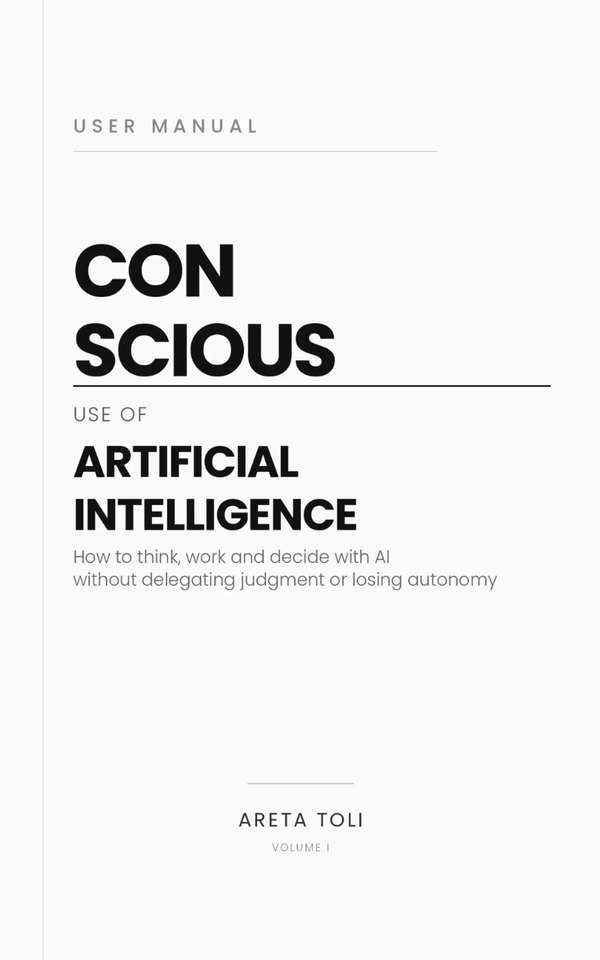
Shelf 01 · Texts · Volume I of a trilogy

The Conscious Use of Artificial Intelligence

How to Think, Work and Decide with AI Without Delegating Judgment or Losing Autonomy

Artificial intelligence is often presented as a tool. This book approaches it from a different perspective.

It is not a technical manual for programmers, nor a collection of prompts. It is a framework of understanding, set out across ten chapters organised as a progressive method.

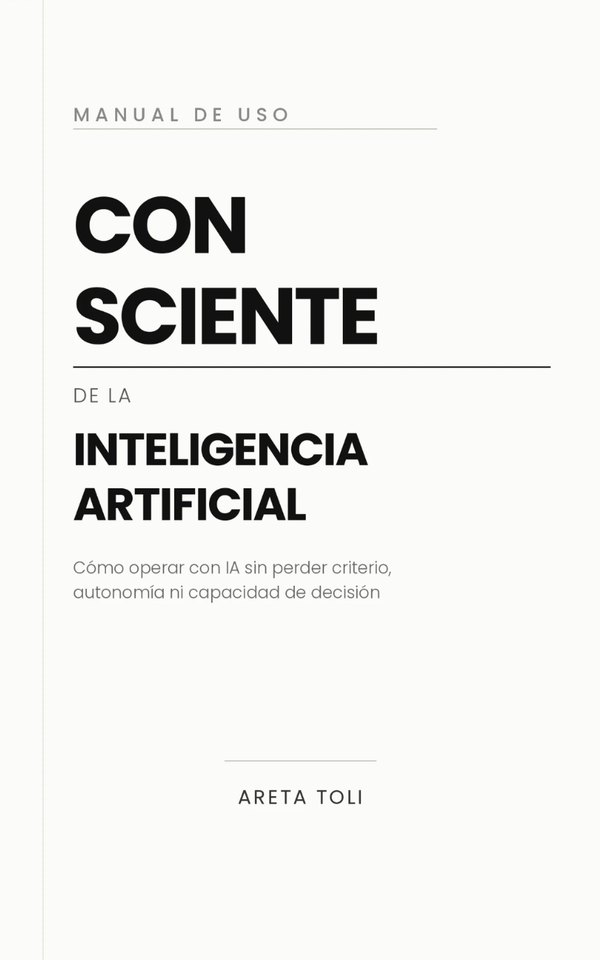
Areta Toli · PDF · Available in English and Spanish

  1. Cover of The Conscious Use of Artificial Intelligence, English edition
    English edition

    The Conscious Use of Artificial Intelligence

    On Payhip (opens in a new tab)
  2. Cover of Manual de uso consciente de la inteligencia artificial, Spanish edition
    Spanish edition

    Manual de uso consciente de la inteligencia artificial

    On Payhip (opens in a new tab)